 Image credit: Richard D. Paul & Alessio Quercia
Abstract
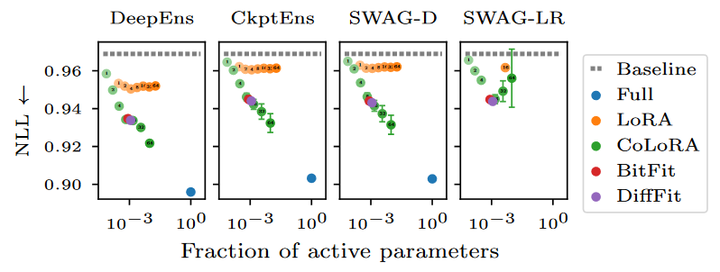
State-of-the-art computer vision tasks, like monocular depth estimation (MDE), rely heavily on large, modern Transformer-based architectures. However, their application in safety-critical domains demands reliable predictive performance and uncertainty quantification. While Bayesian neural networks provide a conceptually simple approach to serve those requirements, they suffer from the high dimensionality of the parameter space. Parameter-efficient fine-tuning (PEFT) methods, in particular low-rank adaptations (LoRA), have emerged as a popular strategy for adapting large-scale models to down-stream tasks by performing parameter inference on lower-dimensional subspaces. In this work, we investigate the suitability of PEFT methods for subspace Bayesian inference in large-scale Transformer-based vision models. We show that, indeed, combining BitFit, DiffFit, LoRA, and CoLoRA, a novel LoRA-inspired PEFT method, with Bayesian inference enables more robust and reliable predictive performance in MDE.

Alessio Quercia
Research Associate @ Forschungszentrum Juelich | CS PhD | ex IBM Research Zurich, WSense
Alessio is a Research Associate at the Machine Learning and Data Analytics Institute (IAS-8) in Forschungszentrum Jülich. He is currently focusing on Data Efficient Learning, Multi-Task Learning, Transfer Learning and Parameter-Efficient Fine-Tuning.