Least but not Last: Fine-tuning Intermediate Principal Components for Better Performance-Forgetting Trade-Offs
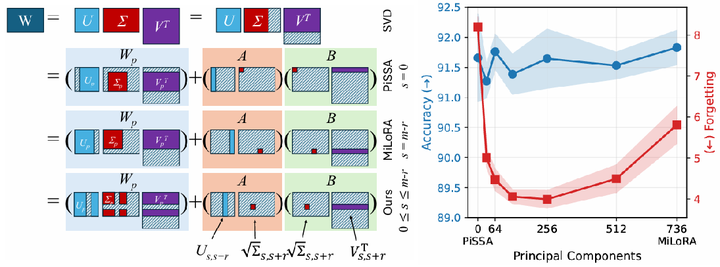 Image credit: Alessio Quercia
Abstract
Low-Rank Adaptation (LoRA) methods have emerged as crucial techniques for adapting large pre-trained models to downstream tasks under computational and memory constraints. However, they face a fundamental challenge in balancing task-specific performance gains against catastrophic forgetting of pre-trained knowledge, where existing methods provide inconsistent recommendations. This paper presents a comprehensive analysis of the performance-forgetting trade-offs inherent in low-rank adaptation using principal components as initialization. Our investigation reveals that fine-tuning intermediate components leads to better balance and show more robustness to high learning rates than first (PiSSA) and last (MiLoRA) components in existing work. Building on these findings, we provide a practical approach for initialization of LoRA that offers superior trade-offs. We demonstrate in a thorough empirical study on a variety of computer vision and NLP tasks that our approach improves accuracy and reduces forgetting, also in continual learning scenarios.

Alessio Quercia
CS PhD Candidate @ RWTH Aachen University & FZJ | ex IBM Research Zurich, WSense
Alessio is a PhD Student in Computer Science at RWTH Aachen and at the Machine Learning and Data Analytics Institute in Forschungszentrum Jülich. He is currently focusing on Data Efficient Learning, Multi-Task Learning, Transfer Learning and Parameter-Efficient Fine-Tuning.